

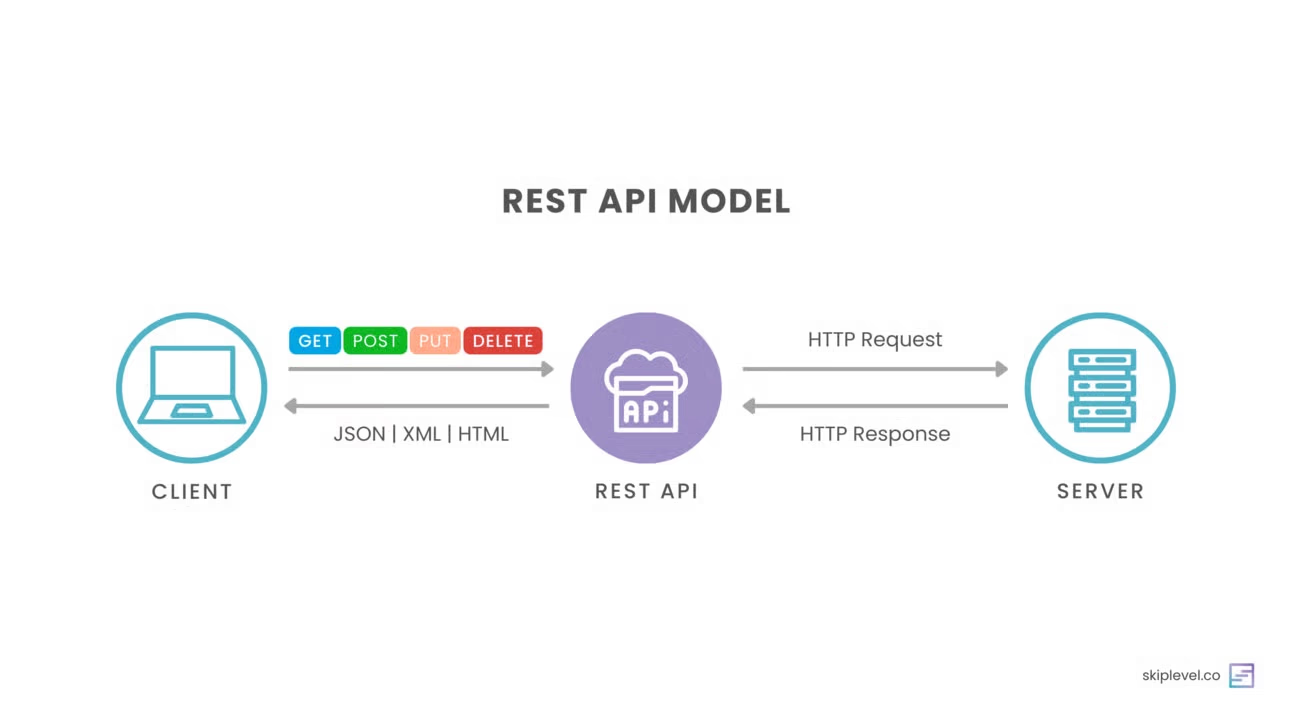
what happens when you call a rest api update?
- Published on
- /21 mins read/
Bạn click "Save" trên UI. Một PUT request bay đi. 200ms sau, data đã update. Nhưng trong 200ms đó, hàng chục components tham gia xử lý — từ TCP handshake, qua reverse proxy, security filters, serialization, transaction management, connection pooling, đến physical disk write trên database server.
Bài này trace toàn bộ journey của 1 UPDATE request từ client đến disk, qua từng layer. Mỗi layer mình sẽ giải thích: nó làm gì, tại sao cần nó, và chuyện gì có thể sai.
Scenario: PUT /api/v1/products/550e8400-e29b-41d4-a716-446655440000 update tên và giá sản phẩm, backend Spring Boot, database PostgreSQL (relational) và MongoDB (document).
# phase 1: client → network → server (0-50ms)
# client tạo http request
Browser/mobile app serialize data thành JSON, build HTTP request:
PUT /api/v1/products/550e8400-e29b-41d4-a716-446655440000 HTTP/1.1
Host: api.example.com
Content-Type: application/json
Authorization: Bearer eyJhbGciOiJSUzI1NiIs...
X-Request-Id: req-7f3a2b1c-4d5e-6f7a
Content-Length: 89

{"name": "Laptop Pro 2024", "price": 25990000}
Tại điểm này, chuyện gì đang xảy ra ở tầng network:
- DNS resolution:
api.example.com→ IP address (cached hoặc query DNS server) - TCP 3-way handshake: SYN → SYN-ACK → ACK (1 round-trip)
- TLS handshake: ClientHello → ServerHello → Certificate → Key Exchange (1-2 round-trips)
- HTTP request gửi qua encrypted TLS tunnel
Nếu dùng HTTP/2 (persistent connection): TCP + TLS handshake đã xong từ request trước → request này gửi ngay trên connection sẵn có (0 round-trips overhead). Đây là lý do HTTP/2 nhanh hơn đáng kể cho subsequent requests.
# load balancer / reverse proxy (nginx/haproxy)
Request đến IP của load balancer trước, không phải trực tiếp đến app server.
Client → [Load Balancer :443] → [App Server :8080]
Load balancer làm gì:
- TLS Termination: Decrypt HTTPS → forward HTTP nội bộ (hoặc re-encrypt)
- Health check: Chỉ route đến healthy instances
- Load balancing: Round-robin, least-connections, hoặc weighted
- Rate limiting: Reject nếu client exceed quota (429 Too Many Requests)
- Request logging: Access log cho monitoring
Sau TLS termination, load balancer forward request (plain HTTP) đến 1 instance của Spring Boot app. Header X-Forwarded-For chứa client IP gốc, X-Forwarded-Proto = "https".
# api gateway (optional — kong, spring cloud gateway)
Nếu có API Gateway layer (microservices architecture):
Client → LB → [API Gateway] → [Product Service]
Gateway thêm:
- Authentication verification: Validate JWT token (check signature, expiry, issuer)
- Route resolution:
/api/v1/products/**→ product-service instance - Request transformation: Add headers, strip prefixes
- Circuit breaker: Reject nếu downstream service unhealthy
- Distributed tracing: Inject trace ID header (OpenTelemetry)
phase 2: spring boot — servlet container (tomcat)
# tomcat nhận request
Spring Boot embed Tomcat server (default port 8080). Khi request đến:
- Acceptor thread nhận TCP connection từ NIO connector
- Poller thread detect data available trên connection
- Worker thread (từ thread pool, default max 200) assigned để xử lý request
- Tomcat parse HTTP: method, URI, headers, body stream
Tomcat Thread Pool (default):
├── max-threads: 200 (worker threads)
├── min-spare-threads: 10 (idle threads ready)
├── accept-count: 100 (queue size khi tất cả threads bận)
└── connection-timeout: 20000ms

Nếu 200 threads đang bận + queue đầy 100 → connection refused (503)
Điều quan trọng: Từ đây, toàn bộ request processing xảy ra trên 1 worker thread duy nhất (blocking model). Thread này bị "occupied" cho đến khi response gửi xong. Đây là lý do thread pool size ảnh hưởng trực tiếp đến throughput.
# servlet filter chain
Trước khi đến Controller, request đi qua chuỗi Servlet Filters. Mỗi filter có thể: modify request, reject request, hoặc pass forward.
Request → [Filter 1] → [Filter 2] → [Filter 3] → ... → [DispatcherServlet]
                                                             ↓
Response ← [Filter 3] ← [Filter 2] ← [Filter 1] ← ... ← [Controller]
Filters thường gặp (theo thứ tự):
// 1. CORS Filter — check Origin header, add CORS response headers
// Nếu Origin không allowed → 403 ngay, không đến Controller

// 2. Security Filter Chain (Spring Security)
//    a. SecurityContextPersistenceFilter — load/create SecurityContext
//    b. JwtAuthenticationFilter — extract + validate JWT token
//    c. AuthorizationFilter — check URL-level permissions
//    Nếu token invalid/expired → 401 ngay

// 3. Request Logging Filter — log request in (method, URI, headers)

// 4. ContentCachingRequestWrapper — buffer body cho re-read (logging/audit)
# spring security — jwt validation chi tiết:
// Bên trong JwtAuthenticationFilter, đây là những gì xảy ra:

// 1. Extract token từ "Authorization: Bearer xxx" header
String token = request.getHeader("Authorization").substring(7);

// 2. Decode JWT (3 parts: header.payload.signature, base64url encoded)
// Header: {"alg":"RS256","kid":"key-id-123"}
// Payload: {"sub":"user-001","roles":["EDITOR"],"exp":1719849600,"iss":"auth.example.com"}

// 3. Verify signature (RSA/ECDSA)
//    - Fetch public key từ JWKS endpoint (cached): auth.example.com/.well-known/jwks.json
//    - Verify: signature matches header+payload using public key
//    - Nếu sai → 401 Unauthorized

// 4. Check claims:
//    - exp > now? (token chưa hết hạn?)
//    - iss == expected issuer?
//    - aud contains expected audience?

// 5. Extract authorities từ token (roles/permissions)
//    → Tạo Authentication object → set vào SecurityContext
//    → SecurityContext attached vào current thread (ThreadLocal)

// 6. Filter chain continues...
Chuyện gì có thể sai ở đây:
- Token expired → 401 (client cần refresh token)
- Token signature invalid → 401 (token bị tamper hoặc key rotation)
- JWKS endpoint down → 401 hoặc 500 (tùy caching strategy)
- Rate limit exceeded → 429
# phase 3: spring mvc — request handling
# dispatcherservlet — front controller
DispatcherServlet là trái tim của Spring MVC. Nó nhận mọi request và dispatch đến đúng handler.
DispatcherServlet workflow:
1. HandlerMapping: "PUT /api/v1/products/{id}" → ProductController.update()
2. HandlerAdapter: setup method arguments (path variables, request body, headers)
3. Execute handler method
4. ResultHandler: serialize return value → HTTP response
# argument resolution — parse request thành java objects
Trước khi gọi controller method, Spring resolve mỗi parameter:
@PutMapping("/{id}")
public ResponseEntity<APIResponse<ProductDTO>> update(
   @PathVariable UUID id,           // ← PathVariableMethodArgumentResolver
   @Valid @RequestBody UpdateProductRequest request,  // ← RequestBodyMethodArgumentResolver
   @RequestHeader("X-Request-Id") String requestId   // ← RequestHeaderMethodArgumentResolver
) { ... }
@RequestBody resolution chi tiết:
- Đọc request body bytes từ InputStream
- Check
Content-Type: application/json→ chọn JacksonMappingJackson2HttpMessageConverter - Jackson
ObjectMapper.readValue(bytes, UpdateProductRequest.class)
- Parse JSON string → JsonNode tree
- Map fields theo tên (hoặc @JsonProperty)
- Call constructor/setters để tạo Java object
- Nếu JSON malformed →
HttpMessageNotReadableException→ 400
@Valid — Bean Validation trigger: 4. Hibernate Validator scan annotations trên UpdateProductRequest 5. Validate từng field: @NotBlank, @Positive, @Size... 6. Nếu violations → MethodArgumentNotValidException → 400 (handled by @RestControllerAdvice) 7. Nếu pass → object sẵn sàng dùng
@Data
public class UpdateProductRequest {
   @NotBlank(message = "Name is required")
   @Size(max = 255)
   private String name;

   @NotNull @Positive(message = "Price must be positive")
   private BigDecimal price;
}
# controller method execution
@RestController
@RequestMapping("/api/v1/products")
@RequiredArgsConstructor
public class ProductController {

   private final ProductService productService;

   @PutMapping("/{id}")
   public ResponseEntity<APIResponse<ProductDTO>> update(
           @PathVariable UUID id,
           @Valid @RequestBody UpdateProductRequest request,
           @RequestHeader("X-Request-Id") String requestId) {

       // Tại đây: chỉ delegate — không có business logic trong controller
       ProductDTO updated = productService.update(id, request);
       return ResponseEntity.ok(APIResponse.success(updated));
   }
}
Controller chỉ là "adapter" — convert HTTP world (request/response) sang application world (service call). Zero business logic here.
# phase 4: service layer — business logic & transaction
# @Transactional — transaction bắt đầu
Khi thread enter method đánh @Transactional, Spring AOP proxy intercept:
@Service
@RequiredArgsConstructor
@Transactional(readOnly = true)
public class ProductService {

   private final ProductRepository productRepository;  // JPA
   private final ProductDocumentRepository documentRepository;  // MongoDB

   @Transactional  // readOnly = false → write transaction
   public ProductDTO update(UUID id, UpdateProductRequest request) {
       // ← TẠI ĐÂY: Spring TransactionInterceptor bắt đầu transaction
       // 1. TransactionManager.getTransaction() called
       // 2. DataSource.getConnection() → lấy connection từ HikariCP pool
       // 3. connection.setAutoCommit(false) → bắt đầu DB transaction
       // 4. Connection bind vào ThreadLocal (TransactionSynchronizationManager)

       Product product = productRepository.findById(id)
           .orElseThrow(() -> new ProductNotFoundException(id));

       // Business logic
       product.setName(request.getName());
       product.setPrice(request.getPrice());
       product.setUpdatedAt(LocalDateTime.now());

       // Save to PostgreSQL
       Product saved = productRepository.save(product);

       // Save metadata to MongoDB
       documentRepository.updateMetadata(id, Map.of(
           "lastModified", LocalDateTime.now(),
           "modifiedBy", SecurityUtils.getCurrentUserId()
       ));

       return toDTO(saved);
       // ← KHI METHOD RETURN THÀNH CÔNG:
       // 1. TransactionInterceptor calls commit()
       // 2. connection.commit() → PostgreSQL commit
       // 3. Connection return về HikariCP pool
       // 4. ThreadLocal cleanup

       // ← NẾU EXCEPTION THROW:
       // 1. TransactionInterceptor calls rollback()
       // 2. connection.rollback() → PostgreSQL rollback
       // 3. Connection return pool
       // 4. Exception propagate lên controller → error response
   }
}
# connection pool (hikaricp) — behind the scenes
Khi DataSource.getConnection() được gọi, HikariCP không tạo connection mới — nó lấy từ pool:
HikariCP Pool State:
├── Total connections: 20 (maximum-pool-size)
├── Active (đang dùng): 8
├── Idle (sẵn sàng): 12
└── Waiting threads: 0

Khi getConnection():
1. Kiểm pool có idle connection không?
  ├── CÓ → return ngay (< 1ms)
  └── KHÔNG + pool chưa full → tạo connection mới (~50-200ms cho PostgreSQL)
  └── KHÔNG + pool đã full → thread WAIT (block) cho đến connectionTimeout (30s default)
      └── Timeout → ConnectionTimeoutException → 500

Connection lifecycle:
- Được tạo bởi pool (TCP connect to PostgreSQL: 3-way handshake + auth)
- Reused across transactions (dozens/hundreds of times)
- Health-checked bởi pool (SELECT 1, hoặc JDBC isValid())
- Evicted khi idle quá lâu (idleTimeout) hoặc sống quá lâu (maxLifetime)
Performance insight: Mỗi connection = 1 TCP socket + 1 PostgreSQL backend process (~10MB RAM on DB server). Pool 20 connections = 20 backend processes. Đây là lý do maximum-pool-size không nên quá lớn — tốn RAM DB server và context-switch overhead.
# aop proxying — cách @Transactional thực sự hoạt động
Spring không modify bytecode. Nó tạo proxy object wrap real service:
Khi inject ProductService:
 Controller nhận → CGLIB Proxy (subclass of ProductService)
 KHÔNG phải real ProductService instance

Call flow:
 controller.update(id, request)
     → proxy.update(id, request)              // Proxy intercept
         → TransactionInterceptor.invoke()    // Begin TX
             → realService.update(id, request) // Actual business logic
         → TransactionInterceptor.commit()    // Commit TX (nếu success)
     ← return result to controller
Đây là lý do self-invocation bypass @Transactional: khi method A gọi this.methodB() trong cùng class, nó gọi trực tiếp (không qua proxy) → không có transaction cho methodB.
# phase 5: jpa/hibernate — object-relational mapping
# findbyid — select query
Product product = productRepository.findById(id).orElseThrow();Bên dưới, Hibernate:
- Check 1st Level Cache (Persistence Context / EntityManager): entity với id này đã load trong session chưa?
- CÓ → return cached entity (0 SQL queries!)
- KHÔNG → tiếp bước 2
- Check 2nd Level Cache (nếu enabled): entity có trong shared cache không?
- CÓ → hydrate entity từ cache
- KHÔNG → tiếp bước 3
- Generate SQL:
SELECT * FROM products WHERE id = $1 - Get PreparedStatement từ connection
- Set parameter:
ps.setObject(1, uuid) - Execute query → ResultSet
- Hydration: Map ResultSet columns → Java object fields
- Đặt entity vào Persistence Context (1st level cache)
- Set entity state =
MANAGED(Hibernate track changes từ đây)
-- SQL thực tế được generate (với format_sql=true):
SELECT
   p.id, p.name, p.price, p.code, p.status,
   p.category_id, p.created_at, p.updated_at, p.version
FROM products p
WHERE p.id = '550e8400-e29b-41d4-a716-446655440000'
# dirty checking — detect changes
Sau khi product.setName("Laptop Pro 2024") và product.setPrice(25990000):
Hibernate KHÔNG gửi UPDATE ngay. Nó chỉ modify Java object trong memory. Entity vẫn MANAGED trong Persistence Context.
Khi nào UPDATE thực sự xảy ra?
- Khi
flush()được gọi (explicit hoặc auto) - Auto-flush triggers:
- Trước khi execute query (đảm bảo query thấy data mới nhất)
- Trước khi transaction commit
- Khi gọi
repository.save()(optional, Spring Data JPA trigger flush)
# repository.save() — persist changes
Product saved = productRepository.save(product);Spring Data JPA's save() implementation:
// SimpleJpaRepository.save() — source code simplified
public <S extends T> S save(S entity) {
   if (entityInformation.isNew(entity)) {
       em.persist(entity);  // INSERT (new entity, no ID)
   } else {
       return em.merge(entity);  // UPDATE (existing entity, has ID)
   }
}
Vì entity đã MANAGED (loaded bởi findById) và đã có ID → merge() called. Thực tế với MANAGED entity, save() không bắt buộc — Hibernate dirty checking tự detect changes và flush khi commit. Nhưng save() explicit hơn và trigger flush sớm hơn.
# flush — generate & execute update sql
Khi flush (trước commit hoặc explicit):
- Hibernate compare current entity state vs snapshot (state lúc load)
- Detect dirty fields: name changed, price changed
- Generate UPDATE SQL (chỉ update dirty columns nếu
@DynamicUpdate, hoặc tất cả columns mặc định)
-- Generated UPDATE (default: all columns)
UPDATE products
SET name = 'Laptop Pro 2024',
   price = 25990000,
   code = 'LP-2024',           -- unchanged nhưng vẫn trong SET (default behavior)
   status = 'ACTIVE',          -- unchanged
   updated_at = '2024-06-19T10:30:00',
   version = 3                  -- optimistic lock: version + 1
WHERE id = '550e8400-e29b-41d4-a716-446655440000'
 AND version = 2               -- optimistic lock: check old version

-- Với @DynamicUpdate (chỉ dirty columns):
UPDATE products
SET name = 'Laptop Pro 2024',
   price = 25990000,
   updated_at = '2024-06-19T10:30:00',
   version = 3
WHERE id = '550e8400-e29b-41d4-a716-446655440000'
AND version = 2- Execute PreparedStatement
- Check
affected rows:
1→ success0→OptimisticLockException(someone else updated between our read and write)
# phase 6: postgresql — từ sql đến disk
# query processing pipeline
Khi PostgreSQL server nhận UPDATE statement
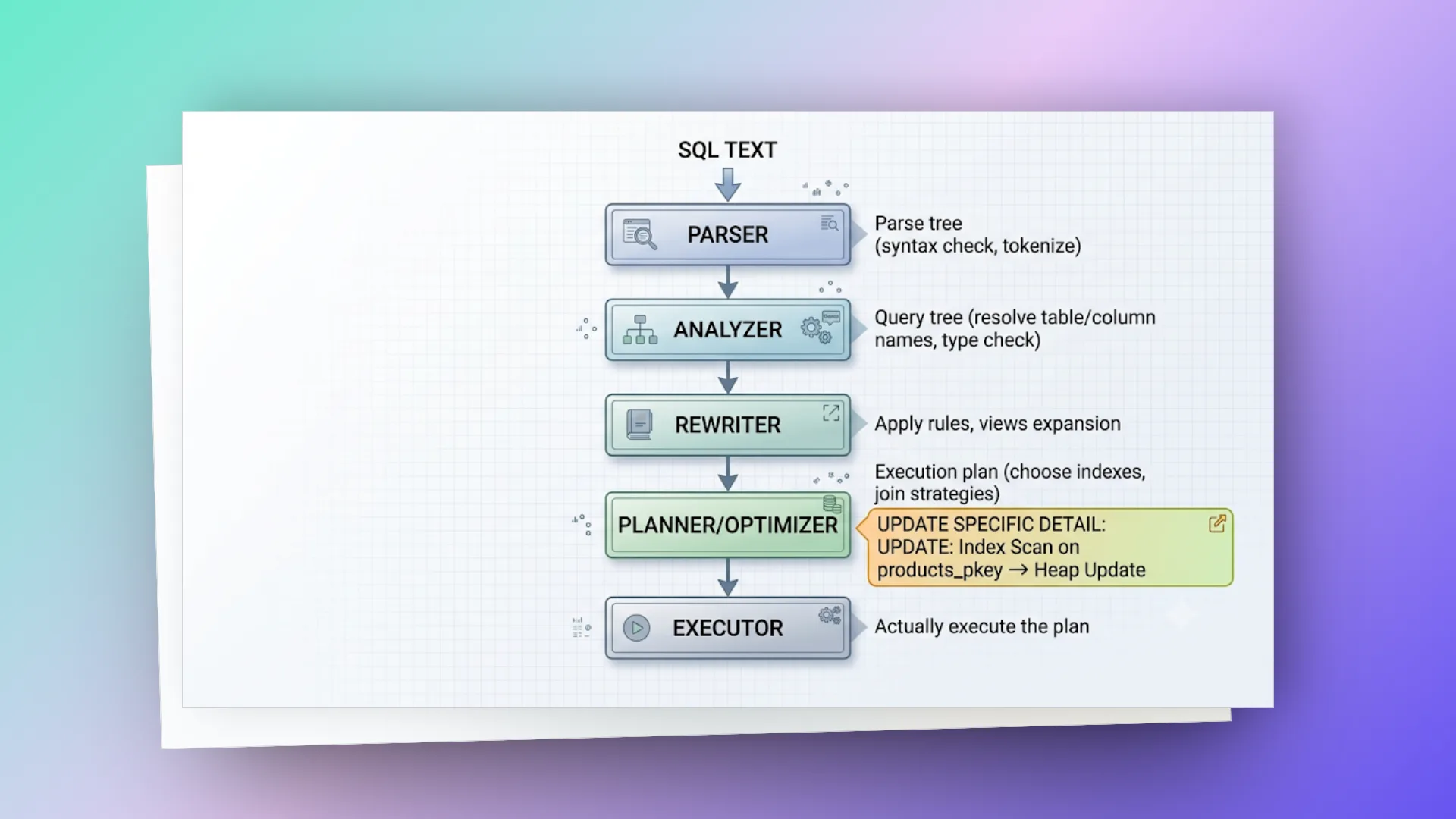
Cho UPDATE cụ thể:
- Index Scan trên
products_pkey(B-tree index trên id column) → tìm row location (page + offset) - Heap access: Read page chứa row từ shared buffers (RAM) hoặc disk
- Row-level lock: Acquire
FOR UPDATElock trên row (block concurrent UPDATEs trên cùng row) - MVCC check: Verify row version phù hợp (
AND version = 2)
# mvcc (multi-version concurrency control) — postgresql's magic
PostgreSQL KHÔNG overwrite data cũ. Nó tạo version mới của row:
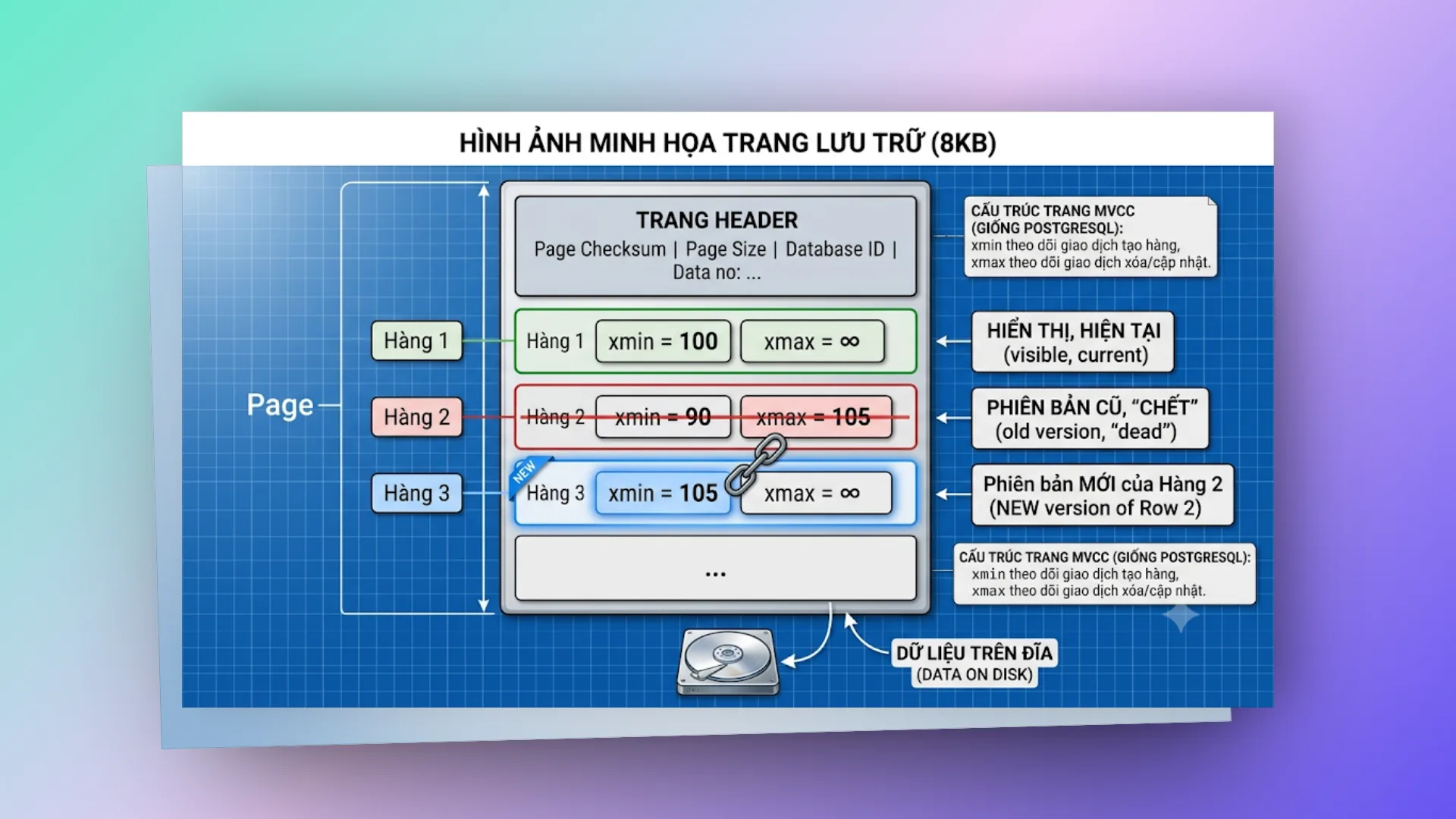
UPDATE tạo:
- Old tuple: set xmax = current transaction ID (mark as "expired")
- New tuple: INSERT với xmin = current transaction ID
- Old tuple KHÔNG bị xóa ngay — VACUUM cleanup sau
Đây là MVCC: readers đọc old version (không bị block bởi writer) writers tạo new version (không block readers)
# wal (write-ahead log) — durability guarantee
TRƯỚC KHI modify data page, PostgreSQL ghi WAL record (write-ahead log):
Thứ tự write:
1. Ghi WAL record vào WAL buffer (memory)
2. Modify data page trong shared buffers (memory)
3. Khi COMMIT: flush WAL buffer → WAL file trên disk (fsync)
4. Data pages flush ra disk SAU (async, bởi background writer/checkpointer)

Tại sao WAL trước data?
- WAL sequential write (fast: ~1-2ms fsync)
- Data pages random write (slow: phụ thuộc vị trí trên disk)
- Nếu crash sau WAL write nhưng trước data write → recovery replay WAL → data consistent
- Nếu crash trước WAL write → transaction chưa commit → data stays old version → consistent
WAL Record cho UPDATE:
├── Transaction ID: 12345
├── Table: products (OID: 16384)
├── Block: 42 (page number)
├── Offset: 3 (tuple index within page)
├── Old tuple: (header + "Laptop Pro", 19990000, ...)
├── New tuple: (header + "Laptop Pro 2024", 25990000, ...)
└── Timestamp: 2024-06-19 10:30:00.123
# index update
Khi row data thay đổi, indexes cũng cần update:
- Primary key index (B-tree on
id): ID không đổi → index entry point to new tuple location (HOT update nếu cùng page) - Secondary indexes (nếu có index trên
namehoặcprice): Insert new entry + mark old entry dead - GIN/GiST indexes (full-text search): Rebuild affected entries
HOT (Heap-Only Tuple) Update: Nếu new tuple fit trong cùng page VÀ indexed columns không đổi → PostgreSQL dùng HOT update (chỉ update heap, không update index). Significant performance win.
# commit — durability moment
Khi Hibernate call connection.commit():
PostgreSQL COMMIT sequence:
1. Write COMMIT WAL record to WAL buffer
2. Flush WAL buffer to disk (fsync) ← ĐÂY là "durability point"
  - Sau fsync thành công: dù server crash, data recoverable từ WAL
  - Trước fsync: data có thể mất nếu crash
3. Mark transaction as committed in CLOG (commit log)
4. Release row-level locks
5. Return success to client (JDBC driver)

fsync latency:
- SSD: ~0.1-1ms
- HDD: ~5-15ms (disk rotation)
- Battery-backed write cache: <0.1ms

Đây là lý do SSD quan trọng cho database: COMMIT speed = fsync speed
# phase 7: mongodb — document update
Nếu service cũng update metadata trong MongoDB (common pattern: relational cho structured data, MongoDB cho flexible/nested metadata):
# mongodb wire protocol
Spring Data MongoDB serialize operation thành BSON (Binary JSON) và gửi qua MongoDB Wire Protocol:
// Spring Data MongoDB operation
documentRepository.updateMetadata(productId, metadata);

// Translated to MongoDB command:
db.product_metadata.updateOne(
   { _id: "550e8400-e29b-41d4-a716-446655440000" },
   { $set: {
       "metadata.lastModified": ISODate("2024-06-19T10:30:00Z"),
       "metadata.modifiedBy": "user-001",
       "metadata.version": 3
   }},
   { upsert: false }
)
# mongodb server processing
MongoDB Update Pipeline:
1. Router (mongos) hoặc Primary nhận command
2. Parse BSON command
3. Acquire document-level lock (WiredTiger: document-level, không page-level)
4. Find document: query _id index (B-tree)
5. Read document từ WiredTiger cache (in-memory) hoặc disk
6. Apply $set operations (modify in-place nếu size không đổi)
7. Write updated document
8. Update indexes (nếu indexed fields thay đổi)
9. Write to journal (WAL equivalent)
10. Return success
# wiredtiger storage engine — behind mongodb
WiredTiger (default storage engine từ MongoDB 3.2) khác PostgreSQL:
WiredTiger vs PostgreSQL:
├── Concurrency: Document-level lock (WiredTiger) vs Row-level lock (PG)
├── MVCC: Cả 2 đều có, nhưng WiredTiger dùng in-place update + journaling
├── Compression: Snappy/zlib/zstd (WiredTiger) vs Toast (PG)
├── Cache: WiredTiger internal cache (50% RAM default) vs Shared Buffers (PG, 25% RAM)
└── Journal: Checkpoint every 60s + journal mỗi 100ms (WiredTiger) vs WAL continuous (PG)
Update in WiredTiger:
- Đọc document vào WiredTiger cache (decompressed)
- Modify document trong cache
- Ghi journal record (durability — mỗi 100ms hoặc mỗi commit nếu
j:true) - Document stays trong cache (dirty page)
- Checkpoint (mỗi 60s): flush dirty pages ra disk (compressed)
# write concern — durability trade-off
MongoDB cho phép tuning durability vs speed:
// Spring Data MongoDB — configure write concern
@Configuration
public class MongoConfig {
   @Bean
   public MongoClientSettings mongoSettings() {
       return MongoClientSettings.builder()
           .writeConcern(WriteConcern.MAJORITY  // Wait majority replicas acknowledge
               .withJournal(true)                // Wait journal flush
               .withWTimeout(5000, TimeUnit.MILLISECONDS))
           .build();
   }
}| Write Concern | Durability | Speed | Risk |
|---|---|---|---|
| w:0 (unacknowledged) | None | Fastest | Data loss on any failure |
| w:1 (default) | Primary only | Fast | Data loss if primary crash before replication |
| w:majority | Majority replicas | Medium | Safe (tolerates minority failures) |
| w:1 + j:true | Primary + journal | Medium | Safe on single node (journal recovery) |
| w:majority + j:true | Majority + journal | Slowest | Safest |
# phase 8: response journey — back to client
# service → controller → response serialization
// Service returns DTO
ProductDTO updated = toDTO(saved);

// Controller wraps in APIResponse
return ResponseEntity.ok(APIResponse.success(updated));

// Spring MVC response handling:
// 1. HandlerMethodReturnValueHandler detect return type = ResponseEntity
// 2. Extract status (200), headers, body (APIResponse<ProductDTO>)
// 3. Content negotiation: Accept header = "application/json" → Jackson
// 4. Jackson ObjectMapper.writeValueAsString(apiResponse) → JSON string
// 5. Write JSON bytes to HttpServletResponse OutputStream
Jackson serialization:
// ObjectMapper traverses object graph:
APIResponse
 ├── statusCode: 200 → "status_code": 200
 ├── data: ProductDTO
 │     ├── id: UUID → "id": "550e8400-..."
 │     ├── name: "Laptop Pro 2024" → "name": "Laptop Pro 2024"
 │     ├── price: BigDecimal → "price": 25990000
 │     ├── updatedAt: LocalDateTime → "updated_at": "2024-06-19T10:30:00" (via JavaTimeModule)
 │     └── null fields → SKIPPED (JsonInclude.NON_NULL)
 └── timestamp: Instant → "timestamp": "2024-06-19T03:30:00.123Z"

// Output ~200 bytes JSON
# response filters (outbound)
Response đi ngược qua filter chain:
- Response logging filter: log response status, size, duration
- Metrics filter: record request duration → Prometheus
http_server_requests_seconds - Security headers: add
X-Content-Type-Options: nosniff,X-Frame-Options: DENY - Compression: nếu client Accept-Encoding: gzip → compress response body
# tomcat → network → client
1. Tomcat write response to socket buffer
2. TCP send: split into segments (MSS ~1460 bytes), send with ACK
3. TLS encrypt (nếu không termination ở LB)
4. Load Balancer forward to client
5. Client receive → parse JSON → update UI

HTTP Response:
HTTP/1.1 200 OK
Content-Type: application/json
Content-Length: 287
X-Request-Id: req-7f3a2b1c-4d5e-6f7a
X-Response-Time: 142ms

{"status_code":200,"data":{"id":"550e8400-...","name":"Laptop Pro 2024","price":25990000,"updated_at":"2024-06-19T10:30:00"},"timestamp":"2024-06-19T03:30:00.123Z"}
# phase 9: after response — async & background
Sau khi response đã gửi, nhiều thứ vẫn xảy ra:
# event publishing (spring events)
// Trong service, event đã được publish:
eventPublisher.publishEvent(new ProductUpdatedEvent(product.getId(), oldName, newName));

// @TransactionalEventListener chạy SAU commit:
@TransactionalEventListener(phase = TransactionPhase.AFTER_COMMIT)
public void onProductUpdated(ProductUpdatedEvent event) {
   // Chạy async — không block response
   cacheService.evict("product:" + event.getProductId());
   searchIndexService.reindex(event.getProductId());
   auditService.logChange(event);
   webhookService.notify(event);
}
# postgresql background processes
Sau COMMIT, PostgreSQL background workers:
├── WAL Sender: replicate WAL records to standby servers (streaming replication)
├── Background Writer: periodically flush dirty pages from shared buffers to disk
├── Checkpointer: every 5 min (default), write all dirty pages + WAL checkpoint
├── Autovacuum: later, clean dead tuples left by UPDATE (MVCC)
│   - Remove old row version (xmax set)
│   - Update visibility map
│   - Update statistics for query planner
└── Stats Collector: update pg_stat_user_tables (seq_scan, idx_scan, n_tup_upd)
# connection return to pool
Sau transaction commit:
1. connection.setAutoCommit(true) — restore default
2. Reset connection state (warnings, savepoints)
3. Return connection to HikariCP pool → available for next request
4. Worker thread return to Tomcat pool → available for next request

Timeline of thread/connection usage:
├── Thread occupied: ~142ms (entire request lifecycle)
├── Connection occupied: ~50ms (from TX begin to TX commit)
└── Actual DB processing: ~5ms (query + update + commit)
# timeline summary — 142ms breakdown
0ms    ─── Client sends request
2ms    ─── TLS/TCP (reused connection)
5ms    ─── Load Balancer → App Server
8ms    ─── Servlet Filters (JWT validation: ~3ms)
12ms   ─── Argument resolution + validation
15ms   ─── Service method enter, TX begin, get connection from pool
18ms   ─── SELECT (findById): index scan + return (~3ms)
20ms   ─── Business logic (set fields): ~0.1ms
22ms   ─── Dirty checking + flush: generate UPDATE SQL
25ms   ─── PostgreSQL UPDATE execution: index scan + row lock + write + WAL
30ms   ─── MongoDB update: find + modify + journal
35ms   ─── COMMIT PostgreSQL: WAL fsync (~1-2ms SSD)
40ms   ─── Release connection, TX complete
42ms   ─── DTO mapping + Jackson serialization
45ms   ─── Response filters (logging, metrics)
47ms   ─── Tomcat write to socket
50ms   ─── Network transit back to client
52ms   ─── Client receives response

After response (async):
60ms   ─── Cache eviction
70ms   ─── Search re-index
80ms   ─── Audit log
100ms  ─── Webhook notification
...    ─── PostgreSQL autovacuum (minutes later)
# điều gì có thể sai? (failure modes)
| Layer | Failure | Impact | Mitigation |
|---|---|---|---|
| Network | Timeout, packet loss | Client gets timeout error | Retry with idempotency key |
| Load Balancer | All backends unhealthy | 503 Service Unavailable | Health checks, auto-scaling |
| Tomcat | Thread pool exhausted | Connection queue full → rejected | Monitor threads, tune pool |
| Security | Token expired | 401 Unauthorized | Client refresh token flow |
| Validation | Invalid input | 400 Bad Request | Clear error messages |
| Connection Pool | Pool exhausted | Thread waits → timeout | Monitor pool, tune max size |
| Database | Deadlock | Transaction rollback → retry | Consistent lock ordering |
| Database | Optimistic Lock | Update rejected (concurrent edit) | Retry or notify user |
| PostgreSQL | Disk full | All writes fail | Monitoring, auto-extend, alerts |
| MongoDB | Primary election | Brief write unavailability | retryWrites=true, write concern |
| Network (internal) | Service-to-DB connection lost | Transaction rollback | Connection validation, retry |
# key takeaways
- 1 HTTP request touches 10+ components — mỗi cái có thể fail independently
- Thread is precious — mỗi request "chiếm" 1 thread suốt lifecycle. Connection cũng vậy. Pool sizes = throughput limit.
- Flush ≠ Commit — Hibernate flush gửi SQL đến DB nhưng chưa durable. Commit + WAL fsync = durable.
- PostgreSQL MVCC: UPDATE = INSERT new + mark old dead. VACUUM cleanup sau. Đây là lý do table bloat nếu VACUUM không chạy đủ.
- MongoDB document-level lock > PostgreSQL row-level lock cho concurrent writes trên different documents, nhưng cùng document vẫn serialized.
- Connection pool size = bottleneck thường gặp nhất. Formula: pool size = ((core_count * 2) + effective_spindle_count). Thường 10-30 là sweet spot.
- Hầu hết latency nằm ở I/O: network round-trips, disk fsync, connection establishment. CPU processing thường < 5% total time.
Chỉ là những ghi chép cá nhân với hy vọng mang lại chút giá trị. Nếu thấy hữu ích, đừng ngại chia sẻ cho bạn bè & đồng nghiệp nhé!
Happy coding 😎 👍🏻 🚀 🔥.
On this page
- # phase 1: client → network → server (0-50ms)
- # client tạo http request
- # load balancer / reverse proxy (nginx/haproxy)
- # api gateway (optional — kong, spring cloud gateway)
- phase 2: spring boot — servlet container (tomcat)
- # tomcat nhận request
- # servlet filter chain
- # spring security — jwt validation chi tiết:
- # phase 3: spring mvc — request handling
- # dispatcherservlet — front controller
- # argument resolution — parse request thành java objects
- # controller method execution
- # phase 4: service layer — business logic & transaction
- # @Transactional — transaction bắt đầu
- # connection pool (hikaricp) — behind the scenes
- # aop proxying — cách @Transactional thực sự hoạt động
- # phase 5: jpa/hibernate — object-relational mapping
- # findbyid — select query
- # dirty checking — detect changes
- # repository.save() — persist changes
- # flush — generate & execute update sql
- # phase 6: postgresql — từ sql đến disk
- # query processing pipeline
- # mvcc (multi-version concurrency control) — postgresql's magic
- # wal (write-ahead log) — durability guarantee
- # index update
- # commit — durability moment
- # phase 7: mongodb — document update
- # mongodb wire protocol
- # mongodb server processing
- # wiredtiger storage engine — behind mongodb
- # write concern — durability trade-off
- # phase 8: response journey — back to client
- # service → controller → response serialization
- # response filters (outbound)
- # tomcat → network → client
- # phase 9: after response — async & background
- # event publishing (spring events)
- # postgresql background processes
- # connection return to pool
- # timeline summary — 142ms breakdown
- # điều gì có thể sai? (failure modes)
- # key takeaways